It's not bad luck. Flies are built to dodge you, and most flyswatters aren't built to compete. This article breaks down the science of why bugs are so hard to hit, the techniques that actually improve your odds, and how tool design changes the outcome. We'll also look at where Slap-a-Fly™, a military-grade flyswatter designed by U.S. Army veterans, fits into solving this exact problem.
Key Takeaways
- House flies process visual threats and begin escape prep within milliseconds, so technique beats raw speed
- Striking from an angle and aiming slightly ahead of the fly's position improves hit rate
- Perforation, surface size, and handle balance raise strike success more than swinging harder
- Wasps, bees, and spiders call for longer reach and wider safety margins than house flies
- Sealing entry points and removing attractants cuts how often you need to swat
Why Flies Are So Hard to Swat
Flies aren't fast by accident. They're equipped with biology specifically tuned to detect and evade an incoming hand. Halteres, small, club-shaped organs behind a fly's wings, act like built-in gyroscopes. They sense rotation through Coriolis forces and feed data straight to the wing muscles, supporting near-instant balance corrections and sharp mid-air turns. Research on these organs shows mechanosensory signals can trigger reflexes in the fly's motor system in about 5 milliseconds. Their eyes are just as much of a problem for you. Compound eyes give flies nearly 360-degree vision, and their visual processing runs faster than ours. Florida International University reports that humans distinguish roughly 60 flashes of light per second, while some flies pick up closer to 250. To a fly, your swatter isn't moving fast at all. It's practically in slow motion. Caltech researchers filmed fruit flies (Drosophila) reacting to a looming threat and watched them reposition their legs and center of mass roughly 200 milliseconds before takeoff. They were pre-planning an escape route before they jumped. Caltech's public summary of the same work notes the fly can be airborne within about 100 milliseconds of first spotting the swatter. That timing window is why cheap swatters miss so often. A slow swing with a small, flimsy head gives the fly time to see the threat, plan an exit, and launch before contact.

"Why Does the Fly Keep Coming Back?"
It probably isn't the same fly. According to Purdue Extension, house flies can go from egg to adult in as little as 7-10 days when they've got a food source and moisture. Nearby larvae, an open trash can, or a gap under the door means new flies keep arriving. The real problem is the breeding pipeline, not one clever survivor.
Proven Techniques to Swat a Bug Effectively
Approach and Timing Tactics
Fast movement is exactly what flies are wired to detect. Do this instead:
- Move slowly on approach. Sudden motion triggers the escape response before you're in range.
- Aim ahead, not at. Caltech researchers recommend targeting slightly ahead of the fly, anticipating the direction of its first jump.
- Strike fast once you're set. Slow approach, quick final motion — that combination is what actually connects.
The "trap and clap" method works well on surfaces. Instead of swinging from a distance, bring the swatter down just above the fly and intercept it as it launches upward — its default escape direction.

Best Practices for a Clean Strike
Small adjustments raise your hit rate more than most people expect:
- Approach from behind or at an angle — flies register threats faster from a straight-on approach they can see coming
- Wait for distraction — a fly that's grooming or feeding reacts slower than one that's alert
- Use a hard, flat surface behind the bug — swatting against a countertop or wall increases impact force and removes an escape route
Technique still only pays off if your swatter can deliver the strike.
Choosing the Right Tools for the Job
Most drugstore flyswatters are thin plastic on a flimsy wire handle. They flex on impact, which softens the strike and lets the bug escape. Surface size, perforation, weight distribution, and handle rigidity all factor into whether a swing actually connects.
Perforation decides whether you connect. A 2024 Physics of Fluids study tested hole patterns on a square swatter head and how porosity changes airflow during a swing.
A solid paddle pushes a pressure wave the fly can sense before contact. A perforated head lets air pass through, so the strike lands cleaner.
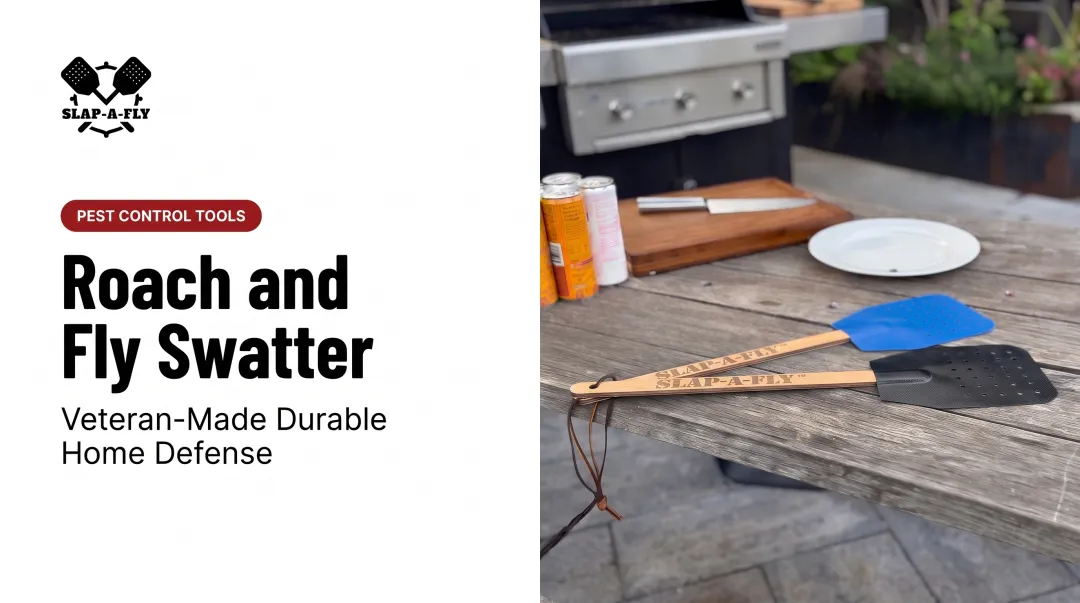
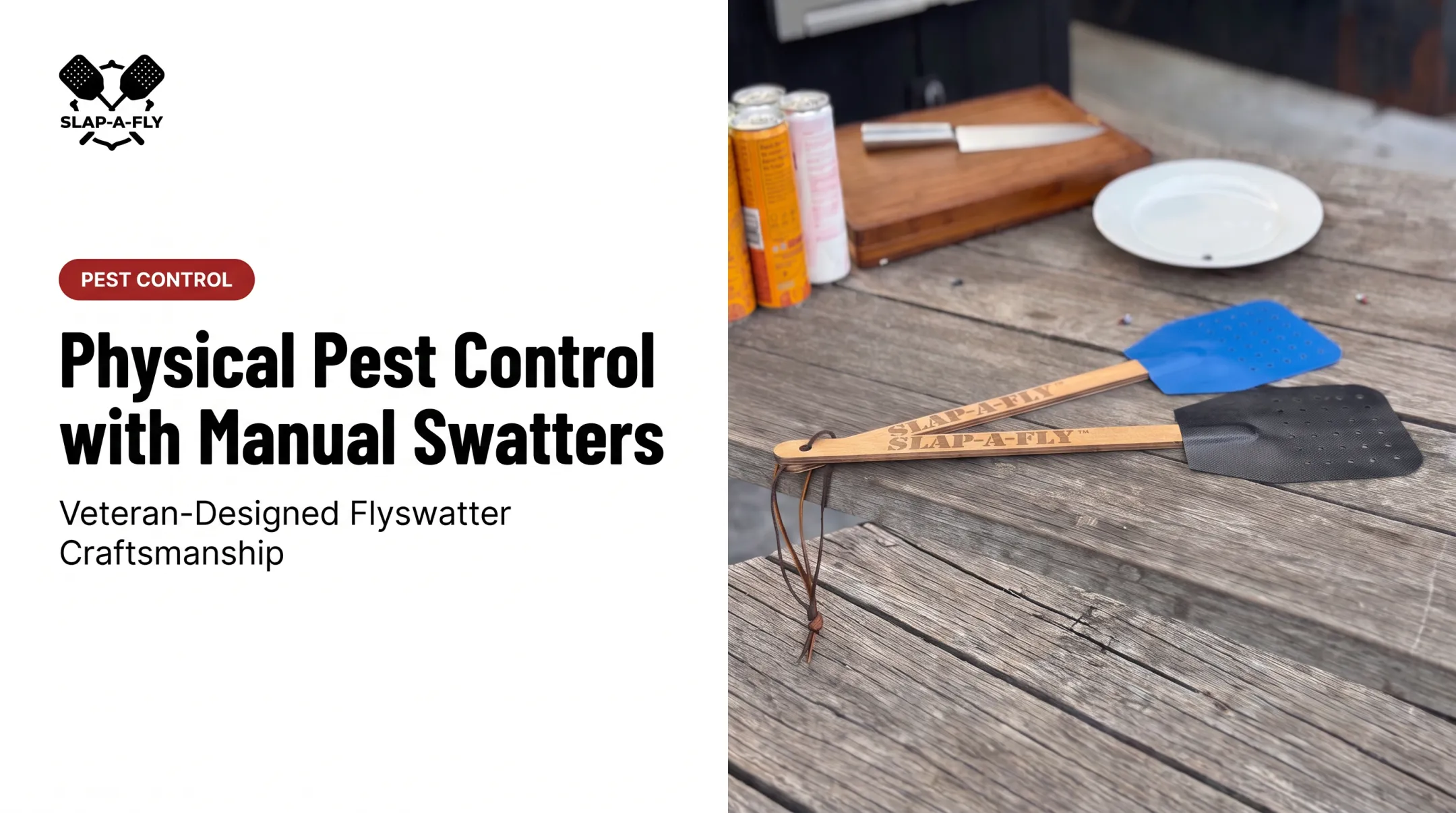
Drugstore swatters fail on more than airflow. Handles snap. Heads fold. Slap-a-Fly's founders, U.S. Army veterans, built a swatter meant to hold up under real kitchen and patio use:
- Herculite 80 MIL-SPEC fabric — synthetic strike surface rated for 80 PSI impact - enough force for large tough bugs like cockroaches, wasps, and armored insects - not just flies - and thousands of hits
- 5-ply aircraft spruce handle — rigid aerospace-grade wood for balance, not flex
- Perforated strike head — cuts air resistance so the swing stays fast
- Storage loop — hang it in reach instead of burying it in a drawer

The XL model adds handle length for extra reach when you want distance from wasps, bees, or high corners. Standard or XL, black or blue, the build is the same; color is cosmetic.
A swatter that cracks after a few weeks is a repeat purchase. Materials rated for thousands of strikes are the ones that stay in the drawer for years, not months.
Preventing Pest Problems Before They Start
The best swat is the one you never have to take. A few habits go a long way:
- Seal entry points — check door sweeps, window screens, and vents; UC IPM finds indoor flies almost always enter from outside
- Remove attractants — clean up spilled food, overripe produce, and standing liquid; sugary residue is a magnet
- Manage trash — tight-fitting lids and regular emptying cut down on breeding sites
- Combine tools — use a swatter for individual bugs; turn to sealed traps or a pro for recurring infestations
A swatter solves the fly on your counter. It won't solve a colony breeding in your trash cans.
Handling Dangerous or Tricky Pests
Not every bug should be treated the same way.
Wasps and bees demand distance. University of Kentucky Extension warns that a threatened nest can trigger a coordinated colony response. Hornets in particular are harder and more dangerous to manage than paper wasps.

This is where an XL swatter's extended handle earns its keep: more distance between your hand and a defensive insect. University of Illinois safety guidance recommends staying calm and slowly walking away if a bee or wasp is nearby rather than provoking it.
Spiders and larger insects often survive a glancing hit from a small, soft head. A wider, firmer striking surface improves the odds of a clean, single hit instead of an escape.
When to skip the swatter entirely:
- Large or established nests
- Nests in hard-to-reach spots requiring a ladder
- Known venomous or aggressive species
Michigan State University Extension notes that professional removal is the right call once a nest threatens people, pets, or livestock. A swatter is for the one bug in the room, not the colony in the wall.
Frequently Asked Questions
Why do flies come back after you swat them?
It's typically not the same fly. Food odors, breeding material, and open entry points keep attracting new flies to the same spot, so it just looks like one persistent bug.
What is the best way to approach a fly without scaring it off?
Move slowly during your approach since flies detect rapid motion easily. Once you're in range, strike quickly from an angle they don't expect, like from behind or the side.
Do flyswatters work better than bug spray for occasional pests?
For a single bug, yes. A swatter kills on contact without chemicals or residue. Sprays make more sense for broader or recurring infestations where you can't target one insect at a time.
Can you use a flyswatter on wasps or bees safely?
An XL swatter's extended reach helps create distance from stinging pests. Still, avoid active nests entirely and use caution around any defensive insect.
How often should flyswatters be replaced?
Cheap plastic swatters often crack or bend within weeks of regular use. Materials rated for thousands of strikes, like military-grade synthetic fabric and aircraft-grade wood, hold up for years.
What household habits attract more flies indoors?
Uncovered food, overflowing trash, pet waste, and standing water are the usual culprits. Cleaning these up regularly reduces indoor fly traffic.