Bluebottle flies aren't just loud and annoying. They breed on decaying flesh and carry bacteria like E. coli and Salmonella, which they can transfer straight onto your food surfaces. A 2017 USDA study found blow flies picked up significantly more E. coli O157:H7 than house flies did, and deposited more Salmonella onto lettuce in controlled testing.
This guide covers how to identify bluebottles, find the source before it gets worse, and the fastest, most practical ways to kill the adults already in your house.
Key Takeaways
- Bluebottles breed in decaying meat or dead animals — removing the source is the only permanent fix
- A heavy-duty flyswatter kills adult flies instantly with zero chemical residue near food
- UV glue traps help manage numbers but never stop the breeding cycle
- One female can lay up to 500 eggs across several batches, so delays let infestations snowball
Understanding Bluebottle Flies
Bluebottles (genus Calliphora) are hard to mistake once you know what to look for. They're roughly double the size of a housefly, at up to about 5/8 inch (16 mm) long, with a shiny metallic-blue abdomen, reddish eyes, and a buzz that's noticeably deeper and louder than a normal housefly drone.
Mississippi State Extension notes they even fly erratically before landing, which is why they're notoriously hard to swat with a flimsy swatter.
Green bottle flies look almost identical, with a green sheen instead of blue — and the same control methods work on both.
The Life Cycle Behind the Swarm
Bluebottles move through four stages: egg, larva (maggot), pupa, and adult. Under warm summer conditions, a 2024 peer-reviewed study found females can lay around 500 eggs across three to four batches. Egg to adult can take as little as 16 to 35 days, depending on temperature.

That short cycle is why several bluebottles indoors are rarely a coincidence. It almost always points to a nearby breeding source, most commonly:
- A dead rodent trapped in a wall void or attic
- A bird carcass in a chimney or crawl space
- Forgotten meat scraps in an outdoor trash bin
How Long Does a Bluebottle Infestation Last?
If you find and remove the breeding source quickly, existing adults typically die off within days to two weeks. Leave the source in place, though, and successive generations keep hatching, stretching the problem out for weeks. There's no single guaranteed die-off day, but the pattern is consistent: no source, no new flies.
Bluebottle Fly Prevention Tips
Prevention comes down to removing what attracts them and blocking their entry points.
- Seal trash tightly. Loose lids and exposed meat scraps are an open invitation.
- Clean up pet waste promptly. Odor is the main attractant, not visibility.
- Install fine-mesh screens. Purdue Extension lists tight-fitting window and door screens as a core way to keep flies out without blocking airflow.
- Check attics, crawl spaces, and sheds seasonally. Dead rodents are a common indoor breeding source, especially after rodent control treatments.
None of this eliminates flies already inside, but it stops the next wave before it starts.
Step-by-Step: How to Get Rid of Bluebottle Flies
Step 1: Find and Remove the Breeding Source
Nothing else works long-term until this happens. Check:
- Attics and wall voids for dead rodents or birds
- Under and behind large appliances
- Garages, sheds, and crawl spaces
- Outdoor trash cans and compost bins
The CDC recommends wearing rubber or plastic gloves and double-bagging any dead rodent before disposal, then washing hands and gloves thoroughly afterward.

Step 2: Deep-Clean the Area
Disinfect the site where the carcass or waste was found. Use an enzyme cleaner or a diluted bleach solution on hard surfaces, and wipe nearby floors and baseboards—eggs and larvae often sit just outside the main mess.
Step 3: Knock Down Adult Flies Fast
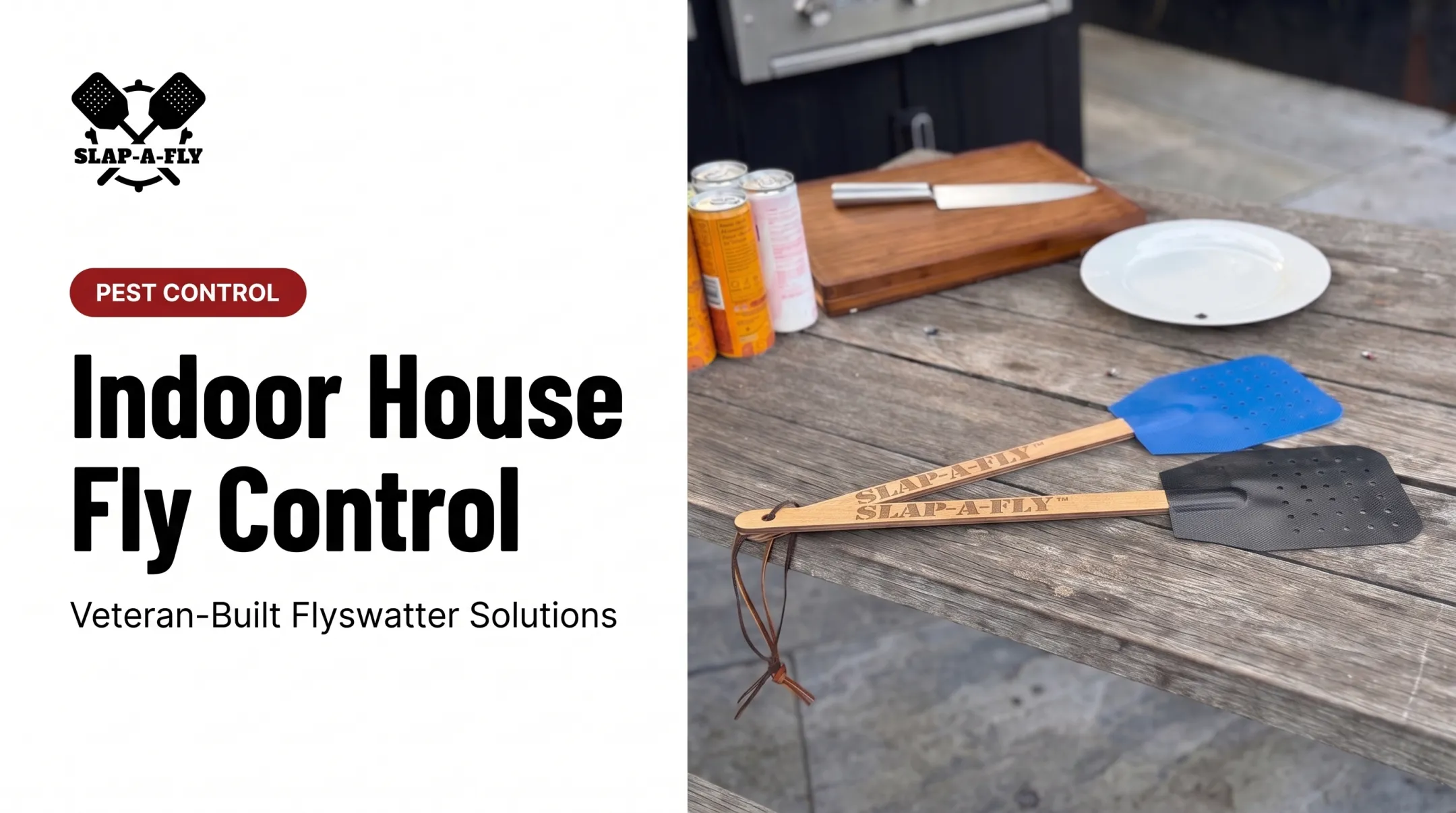
This is where a heavy-duty flyswatter earns its keep. Bluebottles fly erratically and often dodge cheap plastic swatters entirely. Slap-a-Fly's Herculite 80 perforated strike surface, a MIL-SPEC synthetic fabric, delivers 80 PSI of impact force - enough force for large tough bugs like cockroaches, wasps, and armored insects - not just flies - for a single-strike kill with no chemical residue near food prep surfaces.
The construction matters here:
- Perforated surface cuts air resistance so the swatter moves faster and doesn't push air (and the fly) away before contact
- 5-ply aircraft spruce handle is built to withstand thousands of strikes
- The XL model adds a longer handle, giving you extra distance from stinging insects like wasps and bees

In kitchens, that no-residue finish keeps chemicals off counters and cutting boards.
Step 4: Add UV Glue Traps for Ongoing Control
UV glue-board traps help reduce adult numbers passively in kitchens or dining areas. Skip electric zapper-style traps near food, though. A Kansas State study on electrocuting traps found that flies loaded with bacteria released measurable amounts into the air on electrocution. That is the opposite of what you want near a food-prep zone.
Step 5: Use Sprays Sparingly for Heavy Infestations
If numbers are severe, a pyrethroid-based insecticide can help. Keep it away from food surfaces, pets, and children, and treat it as a last resort rather than a first move.
Choosing the Right Fly Killer Method for House Flies
What Is the Best Fly Killer for Bluebottle Flies?
Source removal is the foundation. There's no swatter, spray, or trap that beats fixing the underlying problem. But for immediate, chemical-free kills while you're hunting down that source, a durable flyswatter like Slap-a-Fly outperforms the flimsy dollar-store versions that snap or miss.
Here's how the main methods stack up:
| Method | Speed | Chemical-Free | Stops Breeding |
|---|---|---|---|
| Sprays | Fast | No | No |
| UV glue traps | Slow, passive | Yes | No |
| Flyswatter | Instant | Yes | No |
| Source removal | N/A | Yes | Yes |

That mix of instant kill and zero chemicals is why restaurants, rural households, and farms lean on manual tools. Spot-killing a fly near a prep counter or dinner table shouldn't mean a chemical spray or a bacteria-releasing electric zap.
A durable flyswatter handles it on contact with no residue. A reusable option like Slap-a-Fly means you're not restocking disposable traps every week.
Frequently Asked Questions
What is the best fly killer for bluebottle flies?
Removing the breeding source is the permanent fix. For adults already inside, a durable flyswatter is the most reliable chemical-free option.
How long does a bluebottle fly infestation last?
Anywhere from a few days to two weeks once the breeding source is removed. Left untreated, new generations can keep the problem going for weeks.
Why do bluebottle flies suddenly appear in my house?
They're almost always signaling nearby decaying matter, most commonly a dead rodent or bird hidden in a wall, attic, or crawl space.
Are bluebottle flies dangerous to health?
Yes. They pick up bacteria like E. coli and Salmonella from decaying matter and transfer it onto food and surfaces.
Do bluebottle flies bite?
No, they don't bite. They can still contaminate food surfaces and lay eggs near wounds or exposed food sources.
Can I get rid of bluebottle flies without chemical sprays?
Yes. Source removal, fine-mesh screens, and manual tools like a heavy-duty flyswatter handle most infestations without any chemicals at all.