Roaches are worse. One vibration from your footstep and it's gone before you even lift your arm.
Not all swatters are built the same. Material, perforation, and handle construction determine whether you land a clean kill or spend your evening chasing bugs. This guide breaks down how flies and roaches actually behave, what makes a swatter effective against each, and how to pick the right one for your home.
Key Takeaways
- Flies and roaches react to completely different threats (vision versus vibration), so your swatting technique should differ too
- Perforated, durable strike surfaces outperform solid plastic in both accuracy and lifespan
- Cheap swatters crack or bend within weeks; well-built ones handle thousands of strikes
- Treat swatting as one part of prevention, not a standalone fix
Understanding Your Target: Roaches vs. Flies
Flies and roaches look different, and they detect danger through entirely different senses. That changes how you need to approach the strike.
Houseflies: Fast, Erratic, and Watching You
Houseflies process visual information at a speed most humans can't match. Research suggests some flies can perceive up to 250 flashes per second, compared to roughly 60 for humans. Your swing looks like slow motion to them, according to Florida International University research.
That's why a direct, head-on swat rarely works. A 1991 study on housefly escape responses found that flies react strongly to an approaching object but barely react to one moving away. Your best shot is often an angle they don't expect, not a straight-down swing.
A perforated swatter head matters here too. Holes let air pass through the surface instead of pushing a wall of air ahead of your swing, which gives you a faster, quieter approach.
Cockroaches: Ground Sprinters Wired for Vibration
Roaches don't watch you coming. They feel you.
Cockroaches detect vibration and air displacement through sensory organs on their legs and rear cerci, triggering an almost instant escape response. One study on cockroach escape circuitry measured signal processing in the nervous system at roughly 4 milliseconds. By the time you notice the roach, it may have already sensed you.
This means:
- Approach slowly. Sudden footsteps trigger flight before you're in range
- Strike from a safer distance. An extended-reach swatter gives you room without tipping them off
- Move fast once committed. Hesitation gives them time to bolt
The Dirty-Home Myth
Roaches showing up doesn't mean your house is filthy. According to University of Kentucky Extension, German cockroaches often hitch a ride in grocery bags, cardboard boxes, or delivery packaging, while other species slip in through gaps around doors or firewood. Even clean homes get infested. Poor sanitation just makes it easier for them to stick around once they arrive.
One more practical note: roaches are messier to kill than flies. A light plastic swatter often just crushes the shell without much cleanup control. A sturdy, wipeable synthetic surface makes the aftermath far less unpleasant.
Why a Fly Swatter Doubles as a Roach Weapon
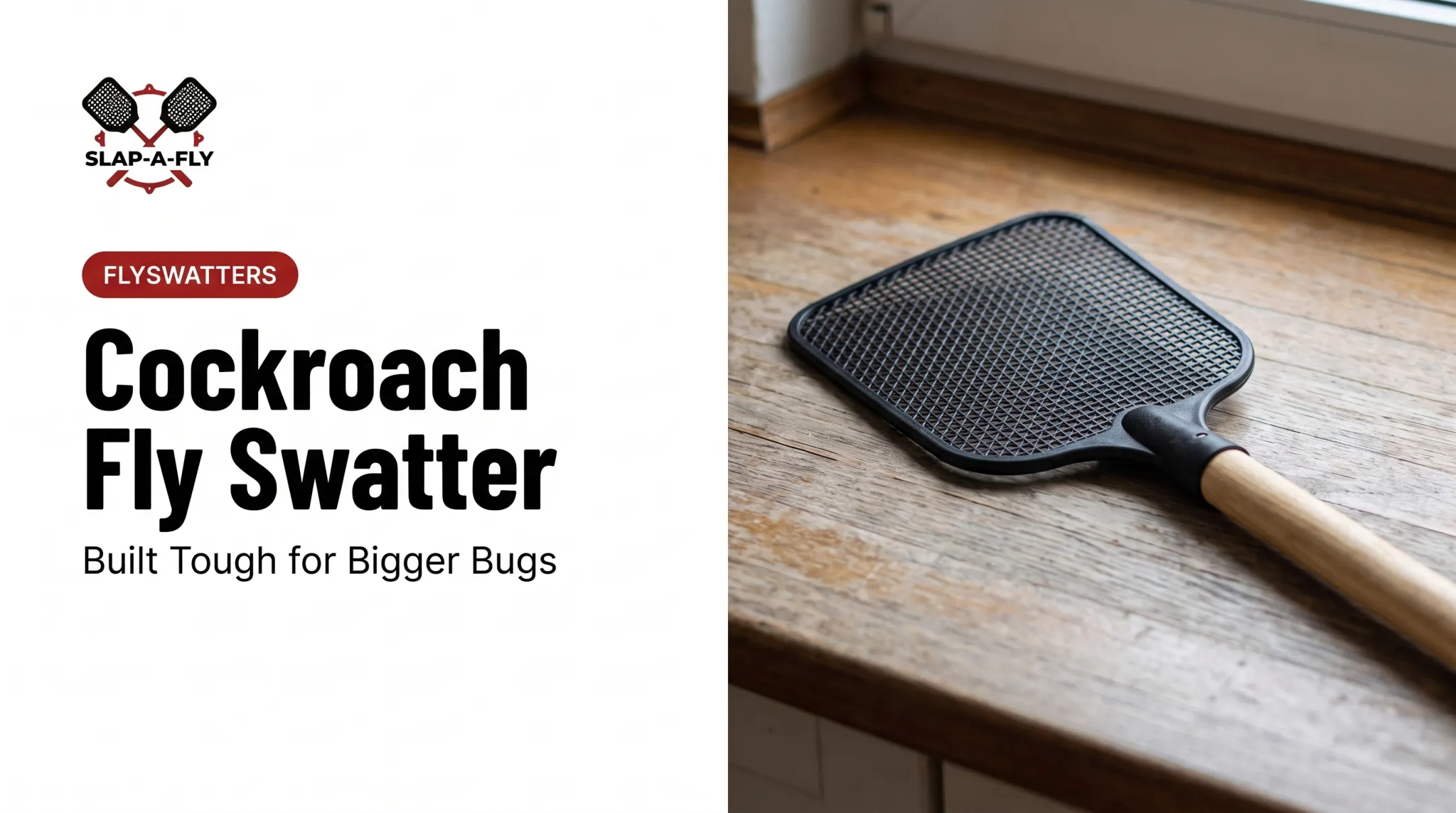
The swinging mechanics are the same for both pests, but roaches have tougher exoskeletons and heavier bodies. A lightweight, flexible swatter that works fine on a fly might just stun a roach, giving it a second chance to run. A heavier, more rigid strike surface improves your odds of a clean first hit, which matters more with roaches since you rarely get a second attempt.

What Makes a Fly and Roach Swatter Actually Effective
Not every swatter is built for this. Four things separate a reliable tool from a frustrating one:
- Strike surface material — determines impact force and durability over time
- Perforation pattern — reduces drag during the swing for a faster, quieter strike
- Handle construction — affects flex, control, and how long it survives repeated use
- Storage accessibility — a swatter buried in a drawer doesn't help when you need it now
Mesh Beats Solid Plastic — Here's Why
A 2024 aerodynamics study published in Physics of Fluids compared a solid swatter head against a porous one, finding that the porous design produced smoother airflow transitions and avoided the abrupt stall behavior seen in solid plates (Physics of Fluids study). In plain terms: perforated heads move through the air more predictably, so you get better control on approach—whether you're timing a fly in midair or lining up a roach on the floor.
Slap-a-Fly's Herculite 80 fabric is built for that job. It's a MIL-SPEC synthetic — the same material category used to line U.S. jet fighter interiors — with weft-inserted polyester scrims for tear resistance. The surface is rated at 80 PSI of impact force - enough force for large tough bugs like cockroaches, wasps, and armored insects - not just flies, so it can deliver a hard, repeatable strike on tougher pests without shredding after a few dozen hits.

Handle Matters More Than People Think
A flexible plastic handle absorbs your swing energy instead of transferring it to the strike. Slap-a-Fly pairs its Herculite 80 surface with a 5-ply aircraft spruce handle — five bonded layers with a high strength-to-weight ratio, enough flex to absorb shock, and real resistance to snapping mid-swing.

One practical extra: the storage loop. Hang the swatter on a hook by the kitchen door or patio so it's in reach the second you spot movement—not buried under junk in a drawer.
Manual vs. Electric vs. Novelty Swatters: Which Should You Choose
| Type | Pros | Cons |
|---|---|---|
| Manual swatter | No batteries, precise control, lightweight, affordable | Requires accurate aim |
| Electric zapper | Instant voltage kill | Heavier, requires charging, messier on roaches |
| Novelty (salt guns, etc.) | Fun for casual outdoor use | Pricier, less practical for real infestations |
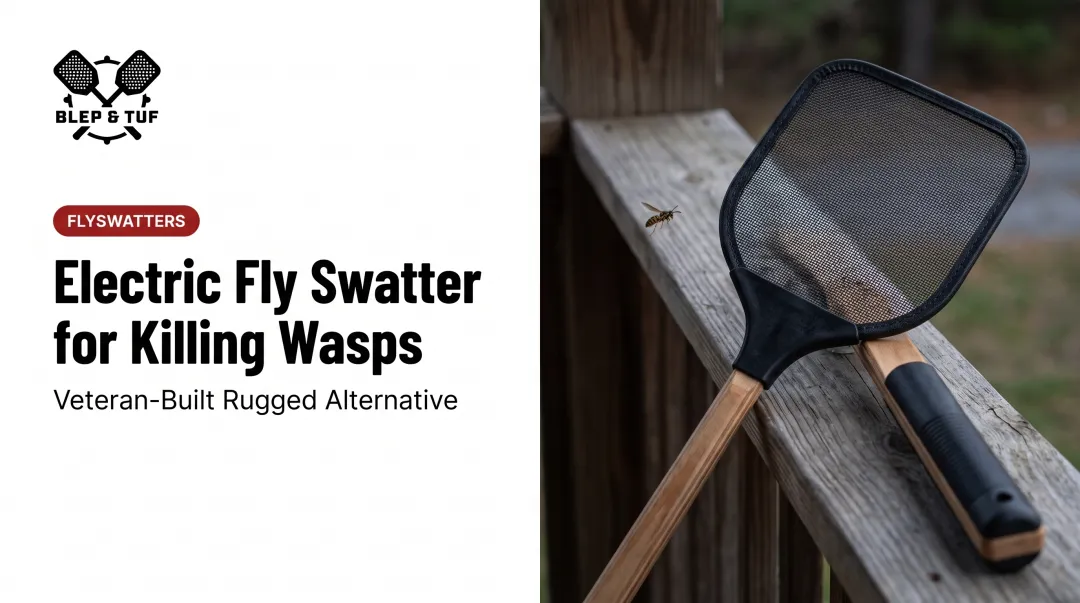
| Electric swatters sound appealing, but they come with tradeoffs. A 2014 case report documented burns when an electric arc ignited nearby alcohol during insect incineration, a reminder these devices carry real fire risk near flammable materials. |

They also tend to run heavier, which tires your arm faster during extended pest battles. The zap can leave roaches in messier condition than a clean manual strike. Manual swatters skip all of that. No batteries, no charging, no ignition risk: just accuracy and control. Novelty tools like salt guns have their place for casual backyard fun, but they're not built for serious kitchen or garage infestations. Save them for outdoor entertaining.
Best Practices for Swatting Roaches and Flies Safely and Hygienically
Roaches aren't just gross to squash. They can carry pathogens. Studies have found bacteria including E. coli and Staphylococcus on cockroach surfaces, and one 2023 study reported bacteria on over 96% of collected cockroaches. That's reason enough to treat cleanup seriously.
Follow these habits:
- Wipe the swatter surface after every roach strike. A disinfectant wipe or soap and water takes seconds
- Wash your hands before returning to food prep or eating
- Use an XL or extended-reach swatter for stinging pests like wasps or bees to keep safe distance
- Pair swatting with prevention: seal cracks, manage food waste, and take out trash regularly
Swatting handles what's already inside your home. It won't stop a real infestation on its own. That requires closing the entry points roaches and flies use to get in.
Frequently Asked Questions
Do fly swatters work on cockroaches?
Yes. A sturdy, perforated swatter with a durable strike surface can kill roaches on contact. Just remember roaches move faster and react to vibration sooner than flies, so quicker reflexes and a careful approach matter more.
Are electronic roach repellents effective?
Not reliably. Iowa State University Extension found no research supporting ultrasonic devices for pest control, and lab repellency results rarely hold up in real homes.
What is the best material for a fly swatter?
Military-grade synthetic mesh fabrics, like Herculite 80, offer more strike force and durability than standard plastic or rubber swatter heads, which tend to crack or lose flex over time.
How do I clean a fly swatter after killing a roach?
Wipe the surface immediately with a disinfectant wipe or soap and water. Roaches can carry bacteria, so quick cleanup reduces the risk of spreading it to countertops or food-prep areas.
Is an electric fly swatter better than a manual one?
Not necessarily. Electric swatters deliver instant shock kills but are heavier and can be messier on roaches. Manual swatters are lighter, more precise, and don't need batteries or charging.
How long should a good fly swatter last?
Premium, military-grade swatters are built to withstand thousands of strikes without breaking down. Dollar-store versions, by contrast, often crack or bend within weeks of regular use.