Most homeowners just grab whatever's nearby and swing wildly. That rarely works. Correct identification is the first step toward actually solving the problem, not just swatting the occasional adult and calling it done.
This guide walks through the five winged flies you're most likely to find indoors, why they're showing up in the first place, and the swatting technique that actually connects.
Key Takeaways
- Five flies cause 90% of household complaints: house flies, fruit flies, drain flies, cluster flies, and fungus gnats
- Identifying the species points you to the breeding source, not just the adult you're chasing
- Flies see nearly 360 degrees around them, so aim slightly ahead of where they're sitting, not directly at them
- A perforated, tension-stable striking surface (like Herculite 80) outperforms floppy mesh over time
- Recurring swarms or larvae sightings mean it's time to call a licensed pest control professional
Identifying Common Winged Flies in the House
House Flies
The classic culprit. House flies (Musca domestica) are gray, about 1/6 to 1/4 inch long, with four narrow black stripes running down the thorax. They fly erratically near food, trash cans, and pet bowls, and they don't bite. According to the University of Minnesota Extension, a fly bouncing off your kitchen window repeatedly is almost always a house fly.
Fruit Flies
Tiny (about 1/8 inch) and tan to brownish-black, usually sporting bright red eyes. They hover rather than dart, and they cluster around ripening bananas, wine glasses, and drains. If your fly problem started right after produce sat out too long, this is your suspect.
Drain Flies (Moth Flies)
These look fuzzy and moth-like, almost like a tiny gray fleck of dust that suddenly moves. They're weak fliers, often just resting on bathroom walls or hovering near sinks. Their wings can carry visible spotting. Find them near a sink or shower? Check the drain first.
Cluster Flies and Speckled-Wing Varieties
A common search question: what kind of flies have speckled wings? The honest answer is that "speckled" gets applied loosely to a few species:
- Drain flies can show visible spotting on their wings
- Cluster flies display a checkered pattern on the abdomen (not the thorax) along with golden thorax hairs
- Fungus gnats can appear mottled under close inspection
Cluster flies themselves are larger and noticeably sluggish compared to house flies. They show up in fall, seeking a warm place to overwinter, often in wall voids or attics before drifting into living spaces.
Fungus Gnats
Small, dark, and mosquito-like, fungus gnats hover around houseplants rather than food. They breed in overly moist potting soil. If you've been generous with the watering can, this is likely your fly.

Why Winged Flies Invade Your Home
Flies get in through the obvious gaps: torn screens, gaps under door thresholds, unsealed vents. Fruit flies are small enough to slip through screen mesh that would stop a house fly entirely. Once inside, food odors and light keep them circling.
Finding the Breeding Source
Swatting adults without finding the source is a losing battle. More will hatch. Work through this checklist:
- Check trash bins and recycling for food residue or spills underneath
- Inspect drains in kitchens and bathrooms for slow drainage or a gelatinous film
- Look at the fruit bowl for anything overripe or forgotten
- Examine potted plants — is the soil staying wet for days?
- Check pet areas for spilled food or waste

Why Speed Matters: The Life Cycle
House fly eggs hatch in as little as 8 to 20 hours, and larvae pass through three growth stages in just 3 to 7 days under warm conditions, according to UNH Extension's house fly fact sheet. Warmer indoor temperatures speed this up further. One study found development at 93°F completed in roughly a week, versus nearly a month at 61°F. That's why a small problem ignored for even a few days can turn into a full swarm.
How to Swat Winged Flies Effectively
Flies are hard to hit because they see almost everything coming — not because they're especially fast. Caltech's research on fly vision found that flies have a nearly 360-degree field of view and can plan an escape route within about 100 milliseconds of spotting motion.
The fix: lead your target. Aim slightly ahead of where the fly is sitting, anticipating the direction it'll jump, rather than swinging straight at its current position.
Technique That Actually Works
- Approach slowly — sudden movement triggers the escape response early
- Strike from an angle, not straight down or head-on
- Commit to the swing once you start; hesitation gives the fly time to react
Why the Swatter Itself Matters
A standard mesh swatter pushes a wall of air ahead of it, and flies feel that pressure change before the swatter arrives. That's why so many swings connect with nothing but air.
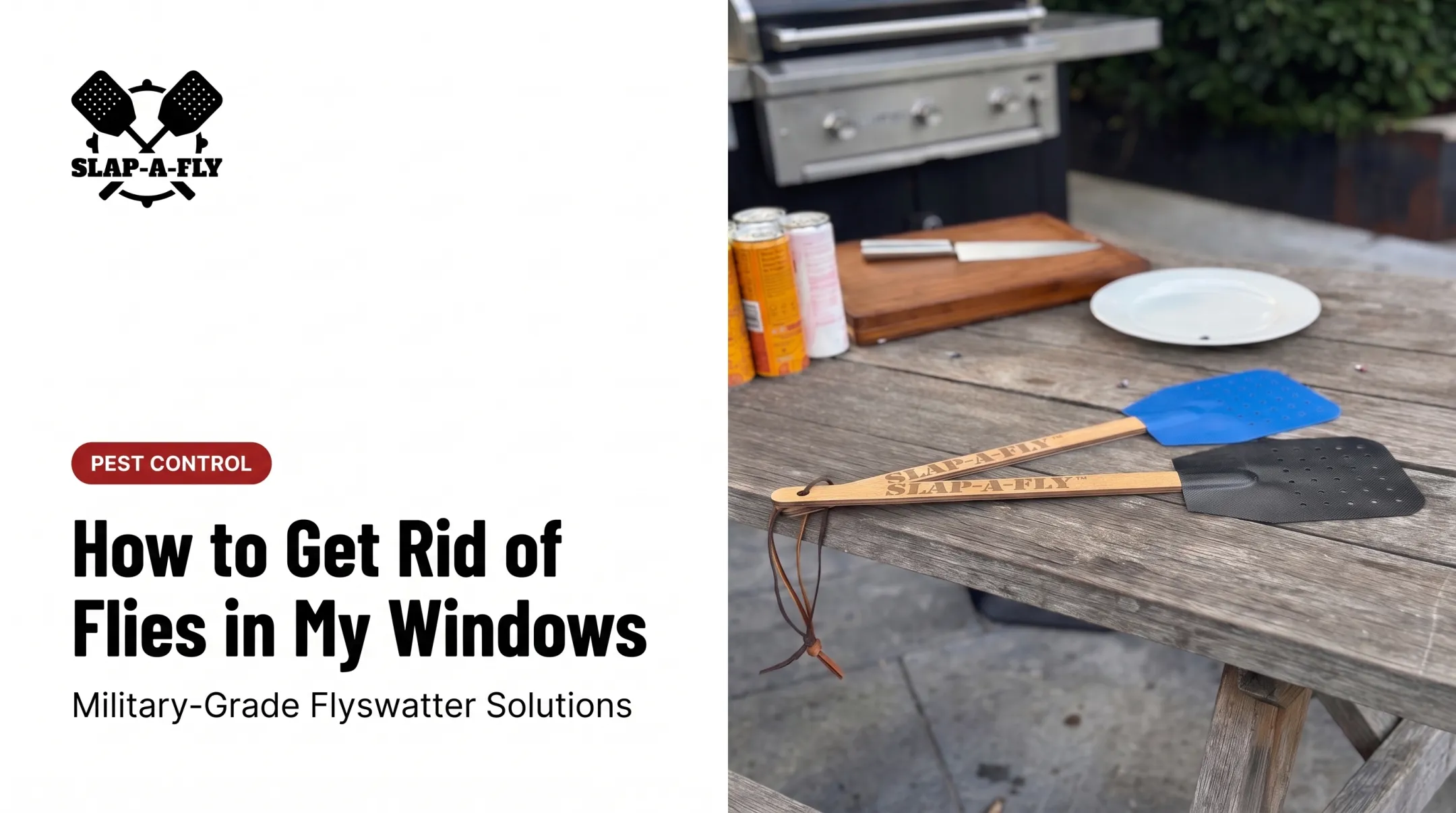
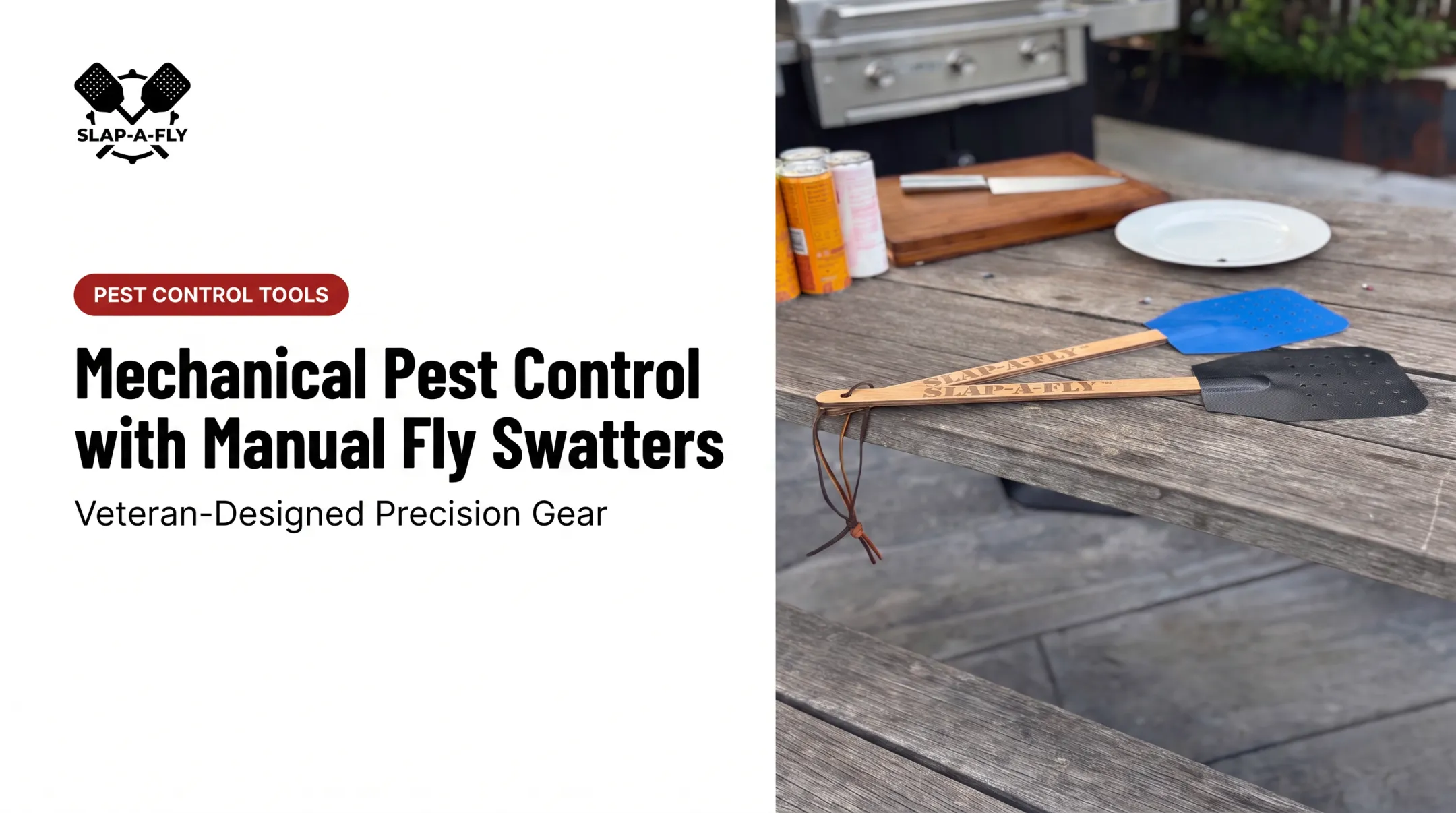
A perforated surface solves that. Slap-a-Fly's military-grade Herculite 80 fabric, engineered by U.S. Army veterans, lets air pass through the strike so pressure doesn't telegraph the hit, and it's rated at 80 PSI of impact force - enough force for large tough bugs like cockroaches, wasps, and armored insects - not just flies:

- Holds tension over thousands of strikes — ordinary mesh stretches and goes floppy within days
- Five-ply aircraft spruce handle for balance and control
- Slap-a-Fly XL adds extended reach and an oversized head for wasps, bees, and horseflies
- Storage loop on both models for hanging near the counter or table
Keep one within arm's reach so you're ready before the next fly settles.
Preventing Future Fly Problems
Swatting handles what's already inside. Prevention keeps new ones from showing up:
- Seal entry points — patch torn window screens, add door sweeps, check vent covers
- Clean regularly — rinse drains weekly, empty trash before it overflows, don't let fruit overripen on the counter
- Dry houseplant soil — let soil dry between waterings to discourage fungus gnats from breeding

None of this eliminates the need for a durable swatter on hand. Even sealed-up, well-cleaned homes get the occasional fly that slips in on an open door.
When to Call a Pest Control Professional
If flies keep reappearing after you've cleaned, sealed gaps, and swatted every adult in sight, something is still breeding out of view.
Common hidden sources include a clogged drain deeper in the pipe, decaying material behind a wall, or an outdoor site near the house.
Call a licensed exterminator if you notice:
- Fly numbers growing despite consistent cleaning
- Maggots or larvae near drains or trash areas
- Persistent activity across multiple rooms
- Swarms returning within days of treatment
Frequently Asked Questions
How long do house flies stay as maggots?
Under warm, favorable conditions, the larval stage lasts about 3 to 7 days before pupating. Cooler temperatures slow this considerably — development can take weeks in cold conditions.
How do you find the source of a fly infestation?
Check trash bins, drains, fruit bowls, and potted plant soil for moisture or organic buildup. Pet feeding areas are another common overlooked spot.
What kind of flies have speckled wings?
Drain flies often show visible spotting on their wings. Cluster flies display a checkered abdomen instead. If you’re unsure, a close-up photo or a professional inspection can confirm the species.
What attracts flies into a house in the first place?
Food odors, standing moisture, and light all draw flies indoors, usually through gaps in screens or door thresholds. Breeding sites like trash and drains keep them coming back.
What is the best way to kill a fly without chemicals?
Swatting is the fastest chemical-free option. Aim slightly ahead of the fly rather than directly at it, since flies detect motion and jump before you strike.
Are winged flies in the house a sign of a bigger infestation?
Occasional flies are usually just wanderers. Recurring swarms, especially with larvae present, typically point to an unaddressed breeding source somewhere in or around the home.