Somewhere between a flea market bin and a museum display case, the humble fly swatter became a legitimate collectible. Enthusiasts chase down wire-mesh originals, Japanese novelty designs, and regional variants with names like vliegenmepper and fliegenklatsche. One collector alone has amassed more than 3,200 pieces.
This guide covers where the fly swatter came from, the styles collectors actually seek, how to start your own collection, and why the same overlooked tool has since been re-engineered into something closer to military gear.
Key Takeaways
- Serious collectors amass thousands of fly swatters in a true niche hobby
- Modern wire-mesh design traces to Robert R. Montgomery’s 1900 U.S. patent — the "King Fly Killer"
- Early 1900s public health campaigns led by Dr. Samuel Crumbine popularized "swat the fly"
- Regional naming, materials, and manufacturing era all drive collectible value
- Designs like Slap-a-Fly show how far the tool has moved past wire-mesh origins
The Origins of the Fly Swatter: From Flabellum to Patent
Long before wire mesh existed, ancient Egyptians used animal-tail fly-whisks (flabella) to keep insects off pharaohs and officials. Museum records date one such object to roughly 1585-1545 BCE. It stands as an ancient precedent for fly control, though it worked more like a brush than a strike-based swatter.
The design that collectors actually chase starts in 1900. Robert R. Montgomery filed a patent for a wire-netting flap attached to a handle, later branded and sold as the "King Fly Killer." It marked the first purpose-built swatter of its kind.
The Marketing and the Sale
A 1901 Ladies' Home Journal advertisement, later reported by the New York Times, claimed the device "kills without crushing" and "soils nothing." That pitch mattered in an era obsessed with hygiene.
In 1903, John L. Bennett bought the patent rights and improved durability by stitching the netting edges to prevent fraying — a small tweak that made the design last.
The Public Health Push
Dr. Samuel Crumbine, a Kansas public health official, championed anti-fly campaigns starting around 1904-1905, helping cement "swat the fly" in the public vocabulary. The slogan spread nationally as hygiene campaigns picked it up across states. That public-health push is a big reason the fly swatter became a household staple rather than a novelty item.

Iconic Old Fashioned Fly Swatter Styles Collectors Seek
Collectors rank a handful of antique swatter styles as the most historically and visually significant.
Wire-mesh oblong swatters from the early 1900s top most want-lists. They represent the original patented design and carry the strongest provenance story.
Regional name variants are a collecting category of their own. Serious collectors track terms like:
- Vliegenmepper (Dutch), confirmed in museum exhibit records
- Fluesmekker (Scandinavian)
- Fliegenklatsche (German)
Novelty and character designs bring personality to a collection. The best-known example is a soft-pink Japanese butterfly-shaped swatter with tiny tweezers built into the handle for disposing of the dead insect. That specific detail helped spark one of the world's largest known collections.
Collectors also seek handcrafted leather and horsehair examples, prized as pre-industrial variants, though documentation on exact origins is thin.
What actually drives value?
- Age: some pieces are estimated to date to the 1920s
- Condition: intact mesh and unbroken handles command premiums
- Country of origin: imported designs often carry novelty value
- Patent and manufacturer marks: when present, they add authenticity

The World's Largest Fly Swatter Collection: A Case Study
If there's a patron saint of fly swatter collecting, it's Iza van Riemsdijk.
Her hobby started almost by accident. During a 1989 trip to Japan, she picked up a pink butterfly-shaped swatter with the built-in tweezers. It was a novelty souvenir. It became a decades-long obsession that grew to more than 3,200 swatters from around the world — museum records put the total above 3,300.
Getting the Collection to Kalamazoo
Transporting more than 1,000 swatters from the Netherlands to Michigan for a Kalamazoo Valley Museum exhibit wasn't simple. U.S. customs officials reportedly asked about the country of origin for each individual piece before clearing the shipment — a logistical headache for what most people would consider junk-drawer items.
The exhibit happened partly because of a personal connection. Van Riemsdijk's family had hosted a Kalamazoo exchange student, Liz Rohs, back in 1966. That friendship endured for decades and eventually brought "SPLAT! The Buzz About Flyswatters" to Michigan, where it ran from June 2023 through January 2024.
How to Start Your Own Fly Swatter Collection
Getting started doesn't require deep pockets, just patience and a good eye.
- Hit flea markets and estate sales first. Old-fashioned swatters often show up in miscellaneous kitchen-tool bins, priced like junk because most sellers don't know what they have.
- Travel with an eye out for regional variants. International trips often yield the best novelty pieces—the same hunting ground that built the world's largest collection.
- Research patent numbers and stamps. Compare construction details to original patent drawings (Montgomery's 1900 filing, for instance) to support authenticity. A patent date alone doesn't prove when a specific piece was made.
- Join collector communities and visit museum exhibits. Forums and shows like the Kalamazoo exhibit teach realistic valuation fast.

One caution: there's no formal authentication standard for antique fly swatters. Treat manufacturer stamps and seller claims as clues, not proof.
From Collectible to Combat-Ready: How Modern Fly Swatters Compare
Antique wire-mesh swatters are charming, but they weren't built to last. The mesh stretches, the netting frays, and repeated strikes eventually turn a once-sharp tool into something that just stuns instead of eliminates.
Modern engineering took a different approach entirely.
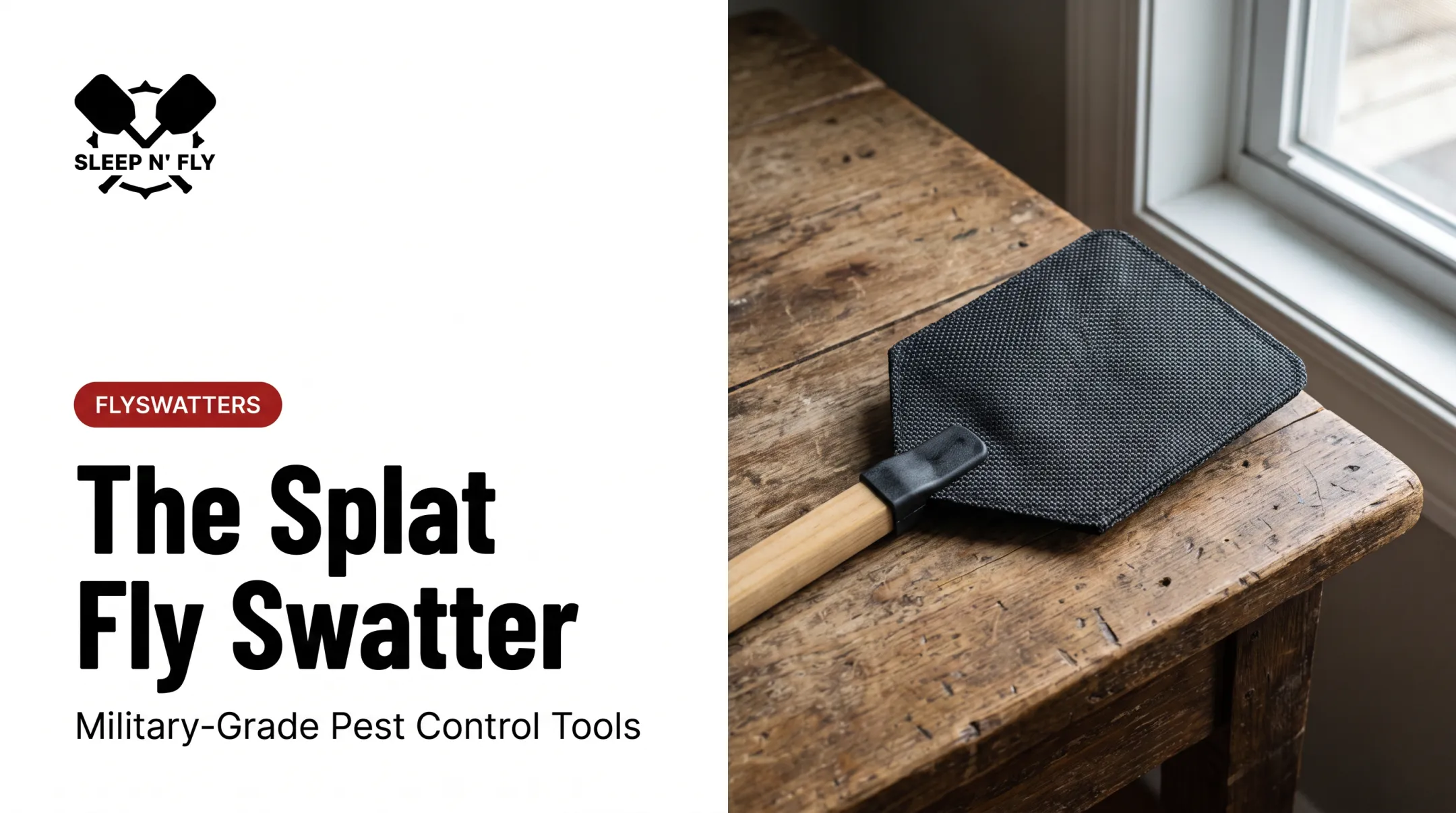
Slap-a-Fly, a veteran-owned, American-made brand, was designed by U.S. Army veterans tired of household swatters that failed mid-swing: flimsy plastic, handles that snapped, mesh that folded on impact. Their fix borrows from aerospace and military-grade materials:
- Herculite 80 fabric, a MIL-SPEC synthetic strike surface rated for 80 PSI of impact force - enough force for large tough bugs like cockroaches, wasps, and armored insects - not just flies - and built to hold tension through thousands of strikes
- 5-ply aircraft spruce handle, the same aerospace-grade wood used in military cargo planes, layered for strength and shock absorption
- Perforated strike surface that cuts air resistance so the swing stays fast without shrinking the striking area
- Storage loop on the XL model for easy hanging between uses

That is a long way from a 1900s wire-mesh flap. The original King Fly Killer was sold as a gentler alternative to crushing insects by hand. Today's goal is single-strike elimination: maximum force in one clean motion.
Current Slap-a-Fly options include:
- Standard ($19.99): everyday flies, mosquitoes, and gnats
- XL ($24.99): tougher pests such as wasps, cockroaches, and large spiders, with extra handle length for safer distance
- Exterminator 4-pack ($42.99): multiple rooms or outdoor zones under heavier pest pressure
Nostalgia collectors will always prize the old wire-mesh originals for what they represent historically. But plenty of those same collectors still keep a modern, durable swatter within reach for the day-to-day job, because a display piece and a working tool don't have to be the same object.
Frequently Asked Questions
What is the best old fashioned fly swatter ever made?
Collectors often cite Robert R. Montgomery's original wire-mesh "King Fly Killer" as the most historically significant piece. Novelty designs, like Japanese butterfly-shaped swatters, are prized separately for craftsmanship and charm.
When was the old fashioned fly swatter invented?
The modern wire-mesh design was patented in the U.S. in 1900 by Robert R. Montgomery. Ancient Egyptians used animal-tail fly-whisks thousands of years earlier, but those were a different tool entirely.
What did the first old fashioned fly swatter look like?
The original patented design was an oblong wire-mesh flap attached to a handle. The mesh allowed airflow while reducing the mess of crushing insects by hand.
Why do people collect fly swatters?
Collectors are drawn to nostalgia, regional design variety, and the novelty of an everyday object turning into a genuine art form. It's an affordable hobby with a deep paper trail of patents, makers, and regional styles.
How can I tell if a fly swatter is a valuable antique?
Check for patent stamps, manufacturer markings, material type, and wear patterns consistent with early production methods. There's no formal authentication standard, so treat these clues as supporting evidence rather than definitive proof.