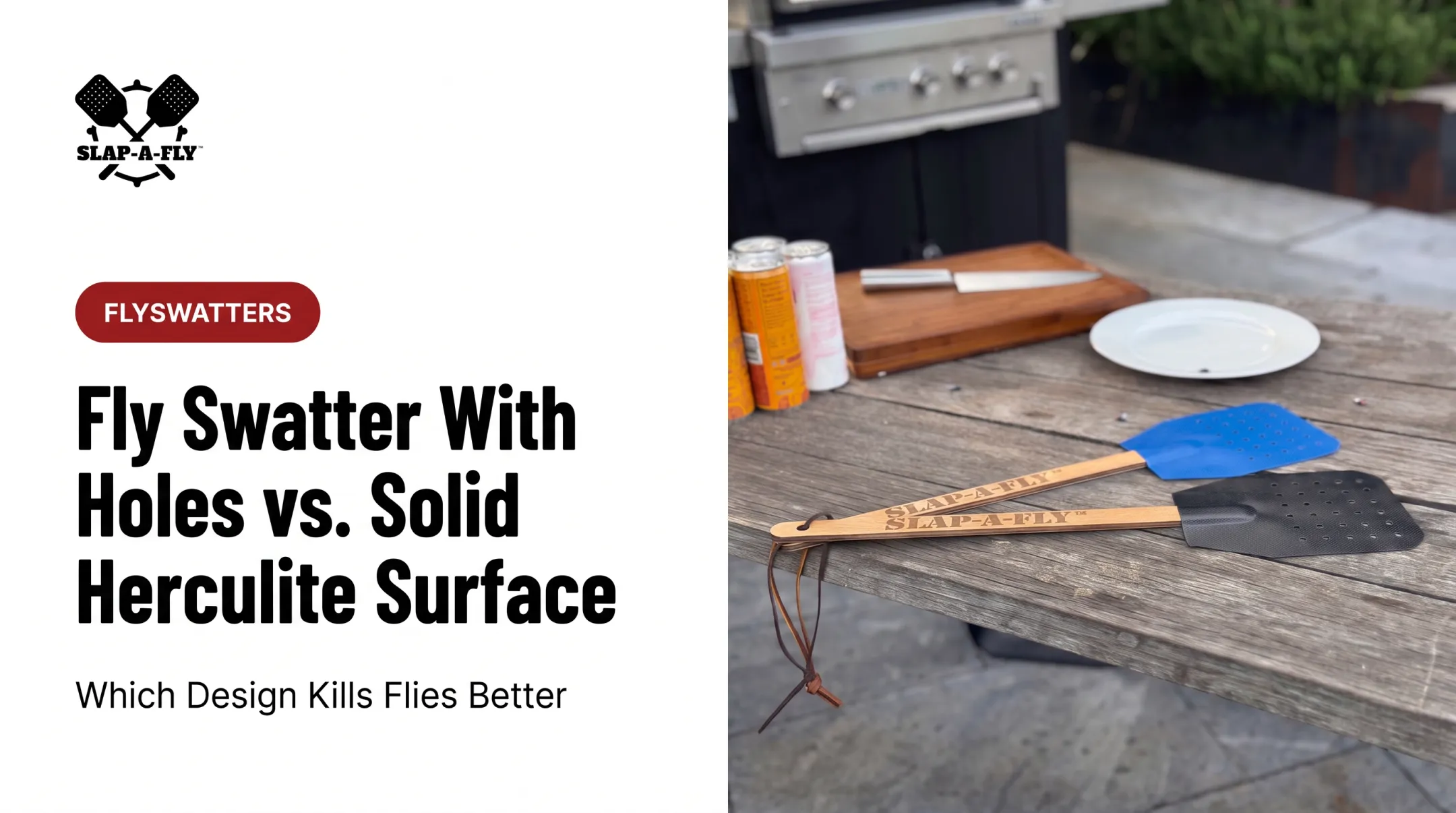
Here's a question most people never stop to ask: why does every fly swatter have holes instead of a solid surface? It seems counterintuitive. Wouldn't more surface area mean a better hit?
The answer isn't manufacturing laziness. It comes down to aerodynamics and how flies actually sense danger. Understanding this science can help you pick a swatter that actually connects instead of just moving air around.
Key Takeaways
- Holes reduce air pressure buildup so the swatter moves faster and gives the fly less warning
- Flies detect air pressure changes and vibrations, so a solid paddle telegraphs the attack before it lands
- Perforated designs, sturdy materials, and fast reaction time raise your strike success rate
- Premium swatters like Slap-a-Fly pair Herculite 80 fabric with engineered holes that cut drag on contact
Why Fly Swatters Have Holes: The Aerodynamics Explained
A solid flat paddle pushes air ahead of it as it swings. That motion compresses a cushion of air directly in front of the surface, creating a pressure wave. Flies can feel that wave coming before the swatter arrives.
Perforations solve this problem. Air passes straight through the mesh instead of piling up ahead of it, which reduces the "gust" warning a fly would otherwise detect.
This matters for physics reasons too. NASA's drag equation defines drag as a function of the object's shape, area, and velocity: D = Cd × ρ × V² × A / 2. Less drag on the paddle means:
- More of your arm's force converts into swing speed instead of fighting air resistance
- Faster acceleration through the strike zone (basic force-mass-acceleration relationship)
- A larger surface area becomes possible without sacrificing swing speed
Hole edges add another effect. Air moving through them creates small turbulence, which can momentarily disorient an insect mid-strike.

Flies rely on tiny mechanosensory hairs to detect air movement. Research on Drosophila's sensory structures shows these hairs are highly sensitive to airflow changes—exactly what a solid paddle triggers and a perforated one minimizes.
Holes aren't about saving plastic. They buy you the split-second advantage a fly doesn't get to react to.
How Flies Detect (and Dodge) Fly Swatters
Flies aren't just lucky. Their entire nervous system is built for rapid escape.
Vision Built for Speed
Human eyes process visual information at a rate that feels smooth to us but looks like slow motion to a fly. Studies on Drosophila report flicker-fusion rates above 100 Hz, meaning flies can perceive far more "frames per second" than humans typically do. A slow, looping swing gives them plenty of visual time to plan an exit.
Air Pressure Is the Real Early-Warning System
Vision isn't even the main defense. Flies have fine mechanosensory hairs covering their bodies that detect subtle air pressure changes and vibrations—often before a swatter is visually identified as a threat.
Once triggered, the escape sequence is fast:
- Sensory hairs detect a pressure shift or looming shadow
- Leg muscles pre-load in milliseconds
- The fly executes a directional jump-and-launch sequence
Drosophila research recorded average takeoff times of just 22 milliseconds after a looming threat crossed a detection threshold. That's faster than you can consciously react.

This is exactly why holes matter. Less air displacement creates less pressure warning, giving that 22-millisecond escape sequence less time to trigger before impact.
The Engineering Behind an Effective Swatter Design
Not all perforated swatters are built the same. Three factors decide whether a swing actually connects:
Material matters. Rigid plastic cracks and warps. Loose wire mesh stretches and goes floppy within days. Slap-a-Fly's Herculite 80 fabric uses weft-inserted polyester scrims for tear resistance, keeping the surface taut through thousands of strikes instead of sagging like cheap mesh. That 80 PSI strike is built for large tough bugs like cockroaches, wasps, and armored insects - not just flies.
Handle balance drives whip speed. A well-balanced handle lets your wrist generate acceleration through the swing rather than just brute-forcing it. Slap-a-Fly pairs its strike surface with a 5-ply aircraft spruce handle, the same category of lightweight, resilient wood used in aircraft cargo applications,built to handle repeated high-force strikes without snapping.
Perforation without sacrifice. The Herculite 80 head uses a perforated surface that cuts air resistance without giving up strike force, and the fabric meets MIL-SPEC durability standards.

For bigger threats, reach matters too:
- XL model: longer spruce handle and a larger strike surface
- Extra standoff distance from wasps, bees, and other stinging pests
- More coverage per swing without slowing the perforated head
If your current swatter feels sluggish or floppy mid-swing, the surface tension—not just the holes—is likely the problem.
A Brief History of the Fly Swatter's Design
The perforated fly swatter isn't a modern gimmick. It dates back to 1900, when inventor Robert Montgomery patented a wire-netting fly-killer (US640790A). Mesh, not solid fabric, was part of the design from day one.
Early designs experimented with various materials before settling into today's standards:
- Wire mesh dominated early 20th-century models
- Wood and metal handles were common through the early 1900s
- Plastic and synthetic mesh became the mass-market standard by the 1940s
Later patents, like a 2009 "clean kill" design, kept refining the perforation concept. Airflow through the holes was treated as a deliberate design feature, not an afterthought. Across more than a century of fly swatter history, one point stays consistent: the holes were never decorative. They solved an airflow problem the first inventors already understood.

Does a Fly Swatter With Holes Actually Kill Flies Better?
Here's the honest answer: holes improve your odds, but they're not a magic bullet.
Perforation helps with swing speed and stealth. But actual lethality also depends on:
- Strike force at the moment of contact
- Material rigidity and surface tension
- How squarely the surface contacts the fly
No controlled study has directly measured perforated swatters against solid paddles or electric zappers for kill-rate percentages, so treat any specific "% more effective" claim online with skepticism. What the science does support is that perforated designs reduce the air-pressure warning that gives flies a head start.
Practical tip: Even with holes, a stationary fly may still sense pressure changes and jump backward right before impact. Aim slightly ahead of its position, not directly at it.
Caltech's fly-response research confirms flies plan their escape trajectory the instant they detect a threat, so leading your target compensates for that reaction time.
Frequently Asked Questions
Do fly swatters actually kill flies?
Yes. A solid strike with enough force overcomes a fly's tiny body mass easily. The key is contact speed and surface coverage, not raw swatter size.
Can flies see or detect fly swatters?
Flies rely more on air-pressure-sensing hairs and vibration detection than on sight alone, though their fast visual processing also helps them spot incoming motion early.
Why do fly swatters have holes?
Holes let air pass through the striking surface instead of pushing a pressure wave ahead of it. This reduces drag, increases swing speed, and gives the fly less advance warning.
What is the best material for a fly swatter?
Durable synthetic fabric, like Herculite 80, holds tension and resists tearing far better than brittle plastic or floppy wire mesh, which stretch and degrade quickly.
Are electric fly swatters more effective than traditional ones?
Electric swatters offer instant-kill voltage but require charging, cost more, and are less portable. Manual perforated swatters trade instant kill for durability, reach, and reliability outdoors.
How can I improve my aim when swatting flies?
Approach from an angle rather than head-on, and aim slightly ahead of the fly's position rather than where it's currently sitting. Flies launch their escape the instant they detect movement.