Here's the problem: a cockroach isn't a fly. Its hardened exoskeleton and split-second reflexes mean the dollar-store swatter that handles gnats often just bounces off, leaving you with an angry, injured roach instead of a dead one.
This guide breaks down whether a fly swatter can actually kill a cockroach, what separates a swatter built for the job from one that isn't, and how to handle the aftermath safely.
Key Takeaways
- A sturdy, high-impact swatter can kill a cockroach; thin plastic models often just stun it
- Roaches need more force and surface coverage than flies—tougher exoskeletons and faster escape reflexes
- Ultrasonic repellents show little proven effectiveness against roaches in real-world use
- Reinforced, perforated swatters handle tougher pests better than a standard fly swatter
Will a Fly Swatter Actually Kill a Cockroach?
Yes, a fly swatter can kill a cockroach, but only if it delivers enough force across enough surface area. Roaches aren't built like flies. Their exoskeleton is dense and layered, meaning a strike that would flatten a housefly instantly might just crack a roach's shell without finishing the job.
Research backs this up. American cockroaches have survived dynamic compression forces around 300 times their body weight in lab settings. Some tolerated close to 900 times body weight without lasting injury, according to a PNAS study on cockroach crevice-traversing biomechanics. That's not a direct swatter-force benchmark, but it explains why weak strikes often fail.
Why cheap swatters underperform:
- Thin plastic heads flex on impact, absorbing energy instead of transferring it
- A partial hit cracks the shell without killing, so the roach scurries off and hides in a wall gap
- Weak swatters sometimes cause the dreaded "explosion" mess: a half-crushed roach that splatters instead of dying cleanly
Speed is the other half of the equation. Roaches can respond to a touch stimulus in as little as 2 milliseconds, averaging around 24.5 milliseconds according to research on antennal-touch escape responses in Periplaneta americana. At running speeds up to 1.5 meters per second (about 5 feet per second), that's enough to dodge a slow, telegraphed swing.

Electric zappers add another wrinkle. They deliver a shock on contact, but that shock doesn't necessarily outperform a well-built manual strike on the first hit, and it does nothing if you miss entirely. A wide head and a fast, decisive swing still matter more than the power source.
What to Look for in a Cockroach-Killing Fly Swatter
Not every swatter is built the same, even if they look similar hanging on a store shelf. Three factors separate a tool that works from one that just makes noise.
Strike Surface and Perforation
A durable, high-density mesh transfers more force per strike than thin, flexible plastic. Perforated designs also cut air resistance, letting the head move faster and connect before the roach senses the motion and bolts.
A 2024 aerodynamics study on commercial fly swatters found that hole pattern and edge porosity directly affect how much air resistance a swatter head generates during a swing, according to research published in Physics of Fluids. More holes generally means less drag, but a pattern that's too open can weaken the head's structure.

Handle Rigidity and Reach
A stiff, well-balanced handle transfers more energy into the strike than a bendy wire one, which flexes and bleeds off force before contact. Reach matters too — roaches can carry bacteria and trigger allergic reactions, so distance works in your favor:
- Longer handles keep your hands clear of the roach's body
- Extra length opens a wider swing arc for fast-moving targets
- Better reach helps you hit targets under furniture or along baseboards
Durability for Repeated Use
A single fly problem might mean a handful of swats. A roach infestation means dozens of strikes over weeks, sometimes longer. Look for high-density synthetic mesh and multi-ply wooden handles that take thousands of hits without cracking or fraying. A head that flexes or splits after a dozen strikes won't hold up once roaches show up regularly.
Slap-a-Fly: Built for Tougher Pests, Not Just Flies
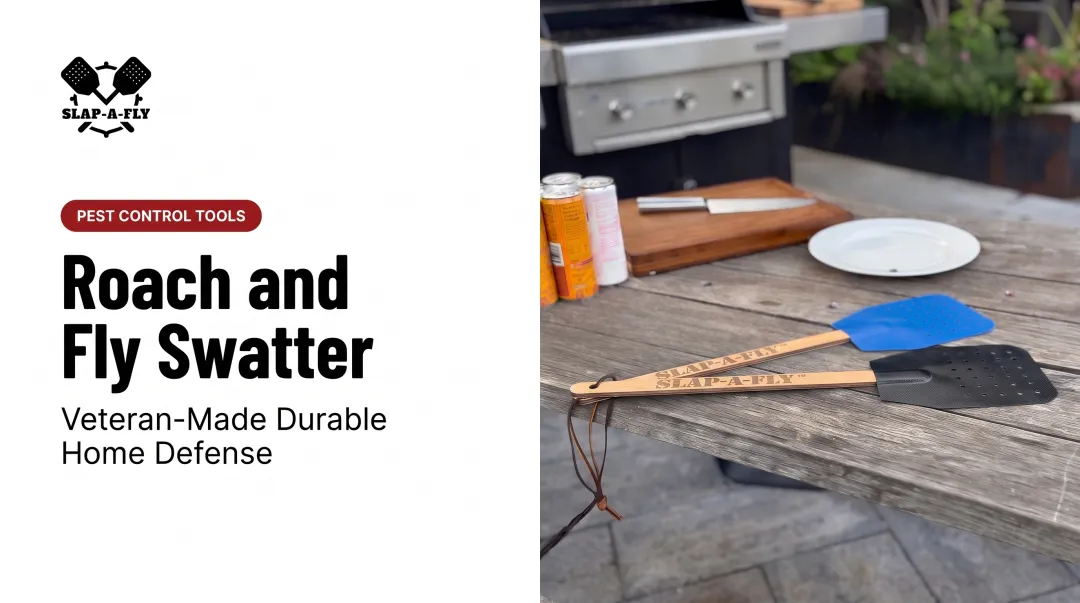
Most swatters on store shelves are made from injection-molded plastic, designed cheaply and meant to be replaced. Slap-a-Fly takes a different approach. It's a veteran-owned, American-made flyswatter built with materials built to military and aerospace specs rather than budget plastics. What sets the construction apart:
- Herculite 80 MIL-SPEC fabric strike surface rated at 80 PSI, with weft-inserted polyester scrims for tear resistance against hard-bodied armored pests like cockroaches and wasps
- 5-ply aircraft spruce handle for rigidity and balance, so more of your swing energy reaches the strike surface instead of getting absorbed by flex
- Perforated strike surface engineered to reduce air resistance, helping the swatter close the distance on a fast-moving roach before it reacts
- Storage loop for hanging near kitchens, pantries, and other spots where roaches tend to hide The XL model adds extended reach, useful for anyone who wants more distance between their hand and a roach's body. It's also built for larger infestation-prone spaces, from home kitchens to commercial food-prep areas dealing with recurring pest issues. Rather than treating swatters as disposable, Slap-a-Fly is a buy-once tool. The fabric and handle are built to take thousands of strikes without breaking down, which matters for households dealing with repeated roach encounters instead of the occasional fly. The XL and Exterminator Bundle are engineered with roaches in mind, but no independent lab test has published single-strike kill rates against cockroaches. Stick to the documented facts: the 80 PSI rating and MIL-SPEC materials. Treat anything beyond that as design intent, not a certified performance guarantee.

Beyond the Swatter: Other Cockroach Control Methods
A swatter handles the roach you can see. It does nothing for the ones hiding in wall gaps or under the fridge.
- Insecticide sprays and gels reach roaches in cracks and crevices a swatter can't touch
- Sticky traps and bait stations monitor activity hands-free over time without constant strikes
- Ultrasonic repellents rarely work at the frequencies most consumer devices use

A 2023 PMC lab study found some frequency-specific effects on German cockroaches, but typical consumer units fell short in the same testing.
For anything beyond the occasional roach sighting, combine a reliable swatter with baits or professional pest control. A swatter alone won't solve an infestation living inside your walls.
Safety and Hygiene Tips When Swatting Cockroaches
Roaches carry more than a startle factor. Research shows they can harbor bacteria, pathogens, and allergens on their bodies, making cleanup just as important as the kill itself.
Strike and cleanup checklist:
- One decisive hit. Repeated light taps injure and scatter the roach—and can spread debris—instead of finishing it.
- Dispose of remains immediately. Don't let a carcass sit near food-prep surfaces.
- Disinfect the strike surface, especially before using the swatter again in a kitchen.
- Wash your hands after handling remains, even briefly.

A 2020 review found that roughly one-quarter of microorganisms isolated from cockroaches were food-borne pathogens, according to a study on cockroaches and food-borne pathogens. That's association, not proof of transmission in every case, but it's reason enough to treat cleanup seriously.
Frequently Asked Questions
Will a fly swatter kill a cockroach?
Yes, provided it has enough impact force and surface coverage to overcome the roach's exoskeleton and speed. Weak, flimsy swatters often just injure it instead.
What is a good device to repel cockroaches?
A swatter kills on contact—it does not repel. For ongoing control, traps and baits beat electronic ultrasonic devices, which have limited real-world effectiveness against roaches.
Can a regular plastic fly swatter kill a roach, or do I need something stronger?
Basic plastic swatters can work on smaller roaches but often fail on larger, faster ones. A reinforced, high-impact swatter is far more likely to stop larger roaches on the first hit.
Are electric fly swatters better than manual ones for roaches?
Electric swatters deliver an instant shock on contact, while a heavy-duty manual swatter relies on concentrated blunt force. Each has situational strengths, but accuracy matters more than the power source.
How do I clean a fly swatter after killing a roach?
Wipe the strike surface with a disinfectant wipe or rinse it under hot water. Do this before reusing it near food-prep areas.
Why do some fly swatters fail to kill cockroaches on the first hit?
Thin, low-force plastic heads and slow swing speed are the most common culprits. Without enough force and speed, roaches survive or simply escape the strike.