Flies are biologically built to dodge. Their nervous systems process threats and plan escape routes faster than most people can react. The good news: once you understand how they evade you, you can beat them at their own game.
This guide covers the science behind fly evasion, proven swatting techniques, the mistakes that sabotage your aim, and the gear that actually makes a difference.
Key Takeaways
- Flies map an escape about 100ms after spotting a threat—before your swing lands
- Aiming slightly ahead of a fly beats aiming directly at it
- Slow approach, fast final strike outperforms a single fast lunge every time
- Perforated surfaces and rigid handles beat raw swing speed for clean kills
- Morning swats work better because flies are less active in cooler temperatures
Why Flies Are So Hard to Swat
Flies aren't dodging randomly. Their biology gives them a serious head start.
They see almost everything at once
A housefly's compound eye contains thousands of individual ommatidia, each sampling a tiny slice of its surroundings. Together, they add up to a nearly panoramic field of view, according to a 2022 study on housefly compound eyes.
There's no sneaking up from a "blind spot" the way you might with a person.
They plan escapes before you finish swinging
In a Caltech study using fruit flies, researchers found the entire escape sequence — detecting a threat, calculating its direction, repositioning legs, and jumping — unfolds in about 100 milliseconds.
Postural adjustments began roughly 200 milliseconds before takeoff, meaning the fly was already planning its move while your hand was still in motion, according to Caltech's research on fly escape responses.

That's the core problem. By the time you've committed to a swing, the fly already picked its exit.
They feel you coming
Fine hairs on a fly's body are believed to detect airflow changes from an approaching hand or object. Similar mechanosensory detection is well documented in other arthropods and in fruit flies' antennae, which adjust rapidly to wind.
A slow, telegraphed swing gives a fly plenty of warning before you're anywhere close.
Core Techniques for Mastering the Swat
Understanding fly behavior only helps if you translate it into technique.
Aim ahead, not at
Since flies calculate an escape trajectory before jumping, striking their current position is a losing bet. The Caltech research showed flies adjust leg position and lean away from a perceived threat, then push off in the opposite direction. Aim slightly ahead, along the direction they're likely to flee, rather than at the spot where they're sitting.
Approach slow, then strike fast
This method works because it exploits how threat detection functions:
- Move slowly toward the fly to avoid triggering an early escape response
- Freeze briefly once you're in range
- Strike fast and decisively the moment you commit
A slow approach doesn't read as an immediate threat. A fast, hesitant approach does.
Attack from behind or above
Flies tend to push off in the direction opposite the threat. If you approach head-on, they'll likely jump backward, straight into your path if you strike where they were. Coming from behind or above forces them into a less predictable escape, often right into your swing.
Get close first
Distance gives a fly more time to detect and react. Closing the gap before you strike shrinks their reaction window dramatically. Reach in slowly, get as close as you reasonably can, then execute the final strike.

Time it for the morning
Housefly activity is temperature-dependent. Research on Musca domestica found locomotor activity rises with temperature and peaks before declining, according to a study on temperature effects on housefly activity. Flies are more sluggish in cooler morning hours. That's your window.
Use a perforated surface, not a solid one
A solid swatter (a rolled-up magazine or a book) pushes a wall of air ahead of it as it moves. That air displacement can tip off a fly before impact even lands. A perforated surface lets air pass through the material instead of building up in front of it.
This is the exact principle behind Slap-a-Fly's Herculite 80 strike surface. It's engineered with evenly spaced perforations so air moves through the fabric rather than getting pushed ahead of it, preserving swing speed while cutting the warning signal a solid object creates. That 80 PSI strike is built for large tough bugs like cockroaches, wasps, and armored insects - not just flies.
Common Mistakes That Ruin Your Aim
Even good instincts fail with the wrong equipment or approach. Watch for these:
- Swatting with books or magazines — solid surfaces displace air and telegraph the strike before it lands
- Swinging from too far away — extra distance means extra reaction time for the fly
- Using a worn-out or flimsy swatter — a strike surface that folds or a handle that flexes on impact kills your accuracy right when it matters
- Aiming at the fly instead of ahead of it — skips the escape-trajectory principle covered above
Each of these mistakes gives the fly information or time it shouldn't have. Fix them, and your success rate jumps immediately.
Choosing the Right Equipment for the Job
Technique only gets you so far if your tool works against you. Handle rigidity, strike-surface material, and balance decide how fast and how accurately you can swing.
Cheap plastic vs. engineered design
Budget plastic swatters tend to share the same failure points:
- Flimsy heads that flex mid-swing
- Handles that snap under force
- Strike surfaces that fold on impact
That flex costs you milliseconds exactly when speed matters most.
Slap-a-Fly's Standard and XL models take a different approach:
| Feature | Cheap Plastic Swatter | Slap-a-Fly (Standard/XL) |
|---|---|---|
| Strike surface | Thin plastic mesh, folds on impact | Herculite 80 MIL-SPEC fabric |
| Handle | Brittle plastic, flexes on swing | 5-ply aircraft spruce |
| Durability | Cracks or bends within weeks | Built for thousands of strikes |
| Design goal | Low cost | Single-strike elimination |

What that means in hand:
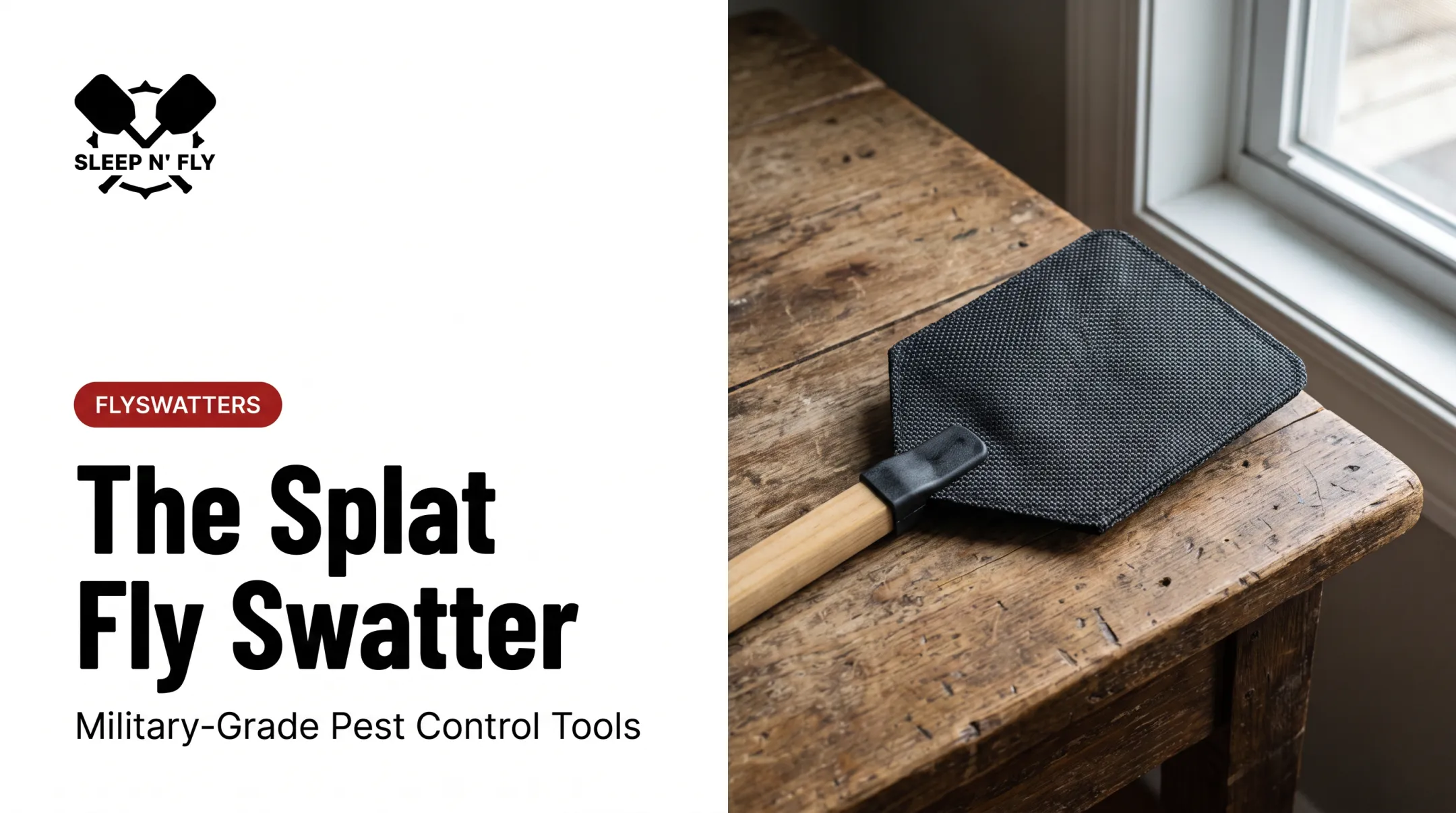
- Herculite 80 — MIL-SPEC synthetic fabric with polyester scrims for tear resistance
- 5-ply aircraft spruce handle — aerospace-grade wood used in military cargo planes, picked for strength-to-weight ratio and shock absorption
For wasps, bees, and higher-risk pests
Stinging insects call for extra distance. An extended handle and oversized strike surface keep you farther from larger, more aggressive pests — the job the XL model is built for.
Keep it within reach
A storage loop at the handle base lets you hang the swatter in the kitchen, on the patio, or at a campsite. When a fly shows up, you want it in your hand in seconds — not buried in a drawer.
Special Scenarios: Kitchens, Outdoors, and Camping
Kitchen counters, camp tables, and patio air all change how you swing—and what holds up after the hit.
Commercial Kitchens and Dining Areas
Food service needs a swatter that survives repeated use and wipes clean between shifts. A Tulsa Health Department food-safety bulletin lists manual flyswatters as an approved tool in food establishments, though local health codes still govern placement and use.
A durable, wipeable surface beats a disposable head that frays after a handful of strikes.
Outdoor and Camping Use
Wind, uneven ground, and larger pests change the equation outdoors. Wait for a brief lull before you commit the swing, and plant your feet so the follow-through stays controlled on soft or sloped ground.
A heavier-duty tool with a rigid handle holds up better than something built only for indoor counters.
Wasps and Bees
Stinging insects call for caution, not aggression. Extension guidance from Oklahoma State University and the University of Illinois both recommend staying calm and avoiding sudden movements at close range rather than swatting hard.
An extended-reach tool adds distance, but identifying the pest correctly before you strike still matters most.
Fly Prevention Tips to Reduce Swatting Frequency
The best swat is the one you never have to take. Remove what attracts and breeds flies, and you cut populations before they become a problem:
- Seal trash tightly — flies lay eggs on garbage and decaying organic matter
- Clean up food spills quickly — especially in kitchens and dining areas
- Manage pet and animal waste promptly — a common breeding site around homes and yards
- Check for rodent activity or decaying matter — indoor debris can attract and breed flies unnoticed
- Reduce excess moisture — damp spots support breeding indoors and out

The Illinois Department of Public Health ranks sealed containers, regular garbage removal, and moisture control among the most effective ways to cut fly breeding sites.
Frequently Asked Questions
Why can't I ever seem to hit a fly with my hand?
Flies detect approaching threats and plan an escape route in roughly 100 milliseconds, often before your swing even lands. Fine body hairs may also pick up airflow changes from your hand, giving them extra warning.
What is the best time of day to swat flies?
Early morning, when cooler temperatures mean lower fly activity. Research on housefly activity shows activity increases as temperatures rise, so flies are more sluggish before things heat up.
Should I aim directly at a fly or somewhere else?
Aim slightly ahead of the fly's position, in the direction it's likely to flee, rather than where it's currently sitting. Flies plan their escape trajectory before you complete your swing, so striking their current spot usually misses.
What household items can I use if I don't have a fly swatter?
A damp dishtowel or slotted spatula can work in a pinch, but both push air ahead of them and lack the rigidity for a clean, instant strike. A purpose-built swatter with a perforated surface performs better.
Are flies dangerous or just annoying?
More than annoying. Houseflies are recognized carriers of over 130 pathogens, including E. coli and Salmonella picked up from waste and decaying matter, according to a systematic review of pathogens carried by houseflies.
Is it safe to swat wasps or bees the same way as houseflies?
Not the same way. Stay calm, avoid sudden movements near a nest, and use an extended-reach tool to keep more distance between you and the insect, since aggressive swatting can trigger defensive stings.