Perforated (holed) surfaces and solid surfaces move through the air differently. That difference affects your swing speed, how long the tool lasts, and how easy it is to keep clean. A 2024 Physics of Fluids study even put this to the test in a wind tunnel — and the results explain a lot about why your swatter drawer is full of failures.
This guide breaks down both designs so you can pick the right one for your kitchen, farm, or backyard.
TL;DR
- Perforated heads let air through, so your swing creates less wake and fewer early getaways
- Solid heads push a denser air cushion forward, which can tip insects off before contact
- Slap-a-Fly uses Herculite 80, a military-grade fabric built around that airflow advantage
- Match the surface to the job: kitchen precision, rugged outdoor use, or casual indoor swatting
Perforated vs. Solid Fly Swatters: Quick Comparison
| Factor | Perforated | Solid |
|---|---|---|
| Air resistance | Holes let air pass, reducing wake turbulence | Pushes a cushion of air ahead of the strike |
| Durability | Tear-resistant fabric like Herculite 80 holds up to repeated strikes | Solid face takes full impact load; plastic or rubber versions crack and warp |
| Cleanup | Debris can pass through openings | Flat surface traps residue, needs more frequent wiping |
| Precision | Faster, more controlled swing | Larger face helps contact; airflow can slow the swing |
| Best for | Kitchens, farms, patios, commercial settings | Casual, occasional indoor use |
Wind-tunnel tests confirm the airflow gap. Researchers compared a porous swatter panel with an identical solid plate and measured wake fluctuations roughly three times stronger on the solid version, along with abrupt stall the porous surface largely avoided. That gap is measured performance, not guesswork.

What Is a Perforated (Holes) Fly Swatter?
A perforated fly swatter has a strike surface covered in evenly spaced holes. Instead of pushing a solid wall of air toward your target, the holes let air slip through as you swing. That matters because insects rely partly on sensing sudden air movement to trigger an escape response. A 2010 housefly sensory-motor study found that houseflies have hair sensilla that respond to airflow across their bodies. A solid swatter shoving a bigger air cushion ahead of it gives the fly more warning. A perforated design, in theory, gives it less. Not all perforated swatters are equal. There's a real gap between:
- Cheap mesh plastic — thin, flexible, and prone to tearing after a season of use
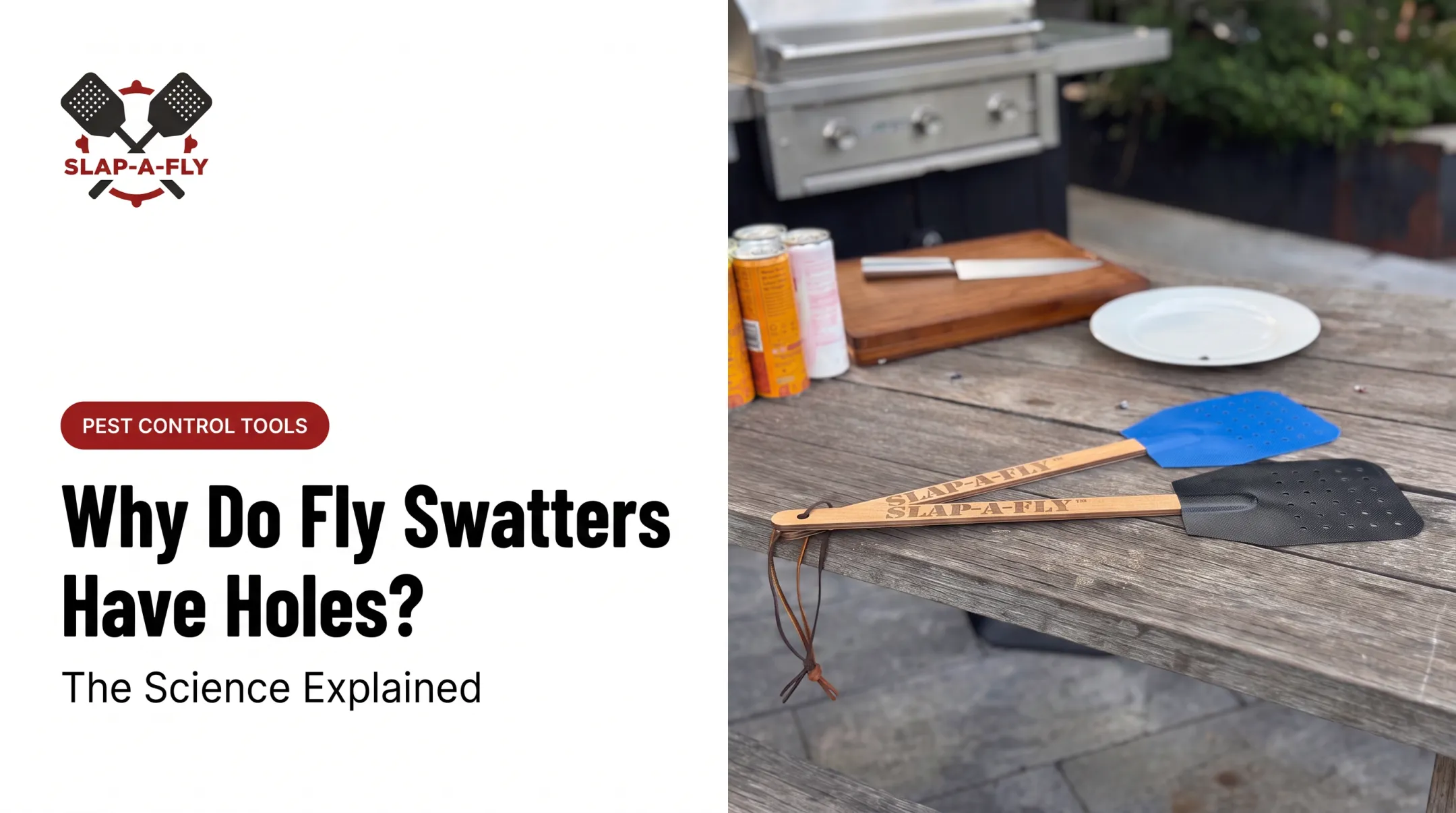
- Military-grade synthetic fabric, like Herculite 80, engineered to hold tension and resist wear under repeated impact Slap-a-Fly's swatters use Herculite 80, a tear-resistant military synthetic fabric, paired with a 5-ply aircraft spruce handle for balance. The company states the surface delivers 80 PSI of impact force - enough force for large tough bugs like cockroaches, wasps, and armored insects - not just flies - and is rated to withstand thousands of strikes.

Use Cases of Perforated Swatters
Perforated designs tend to show up where fly problems are constant, not occasional:
- Commercial kitchens and restaurants — fast, sanitary strikes matter when health inspectors are watching
- Farms and rural households — barn flies don't quit, so the tool can't either
- Campers and outdoor enthusiasts — durability against heat, dust, and repeated use
What Is a Solid Fly Swatter Surface?
A solid swatter has a continuous, unbroken strike surface, usually molded plastic or flexible rubber. There are no holes for air to escape through during the swing.
The main upside is surface area. A bigger, uninterrupted paddle means more room for error if your aim is slightly off. But that same solid panel has to push air out of the way as it moves, which slows the swing and can alert the insect before the swatter arrives.
Two common variations:
- Rigid plastic paddles — cheap, lightweight, but prone to snapping or warping with heat exposure
- Flexible rubber heads — bend on impact but can lose shape over repeated use
Good Housekeeping's 2025 testing found that flexibility mattered more than surface material in avoiding breakage; products with some give held up better against hard surfaces than fully rigid ones.

Use Cases of Solid Swatters
Solid swatters fit a narrower job description:
- Budget multi-packs sold for occasional household use
- Dollar-store products where low cost matters more than performance
- Light indoor use against slower insects, like stationary house flies on a windowsill
Perforated vs. Solid: Which Is Better and Real-World Example
There's no universal winner here. It comes down to how often you're swatting and what you're swatting at.
Key factors:
- Frequency of use: daily kitchen battles need different gear than an occasional summer fly
- Insect type and speed: fast-flying houseflies reward quicker, controlled swings
- Environment: a farm barn, an RV, and a backyard patio all put different stress on materials
- Cleaning routine: how often you're willing to wipe down the tool

For serious, repeated pest control in restaurant kitchens, farm outbuildings, or backyard cookouts, a perforated design built from durable fabric holds up better than a plastic paddle that cracks after a few months.
Slap-a-Fly's approach reflects this thinking directly. U.S. Army veterans designed the swatters to pair a perforated Herculite 80 surface with a 5-ply aircraft spruce handle, the same wood type used in military cargo planes. The goal was balance and reduced air resistance in one swing, not just a bigger paddle.
A practical scenario: Picture a small diner kitchen going through a cheap plastic swatter every few weeks. The head cracks, the handle splits, and flies keep slipping past the flat, air-pushing surface.
Swap in a durable perforated design built for thousands of strikes, and you get fewer replacements and fewer misses when it counts.
Match the swatter to your environment. For a serious, ongoing fly problem, Slap-a-Fly's perforated Herculite 80 models are built for that kind of daily demand.
Conclusion
Perforated surfaces win on airflow, durability, and long-term hygiene. A solid surface can still work if you swat a fly twice a summer and don't want to spend much.
In a kitchen, on a farm, or in a backyard that never stays fly-free, the difference shows up fast—fewer missed swats, a swatter that lasts more than one season, and less mess left behind. A military-grade perforated option like Slap-a-Fly is built for that kind of use.
Frequently Asked Questions
Why do fly swatters have holes in them?
Holes let air pass through the strike surface instead of pushing a solid cushion of air ahead of the swing. This reduces the disturbance the insect might sense before contact.
What are the best tips for swatting flies?
- Approach from an angle rather than head-on
- Aim slightly ahead of the fly’s position
- Use a quick, controlled wrist snap instead of a big wind-up
Do flies know when you have a fly swatter?
Flies respond strongly to visual motion, especially an approaching object, and have tiny sensory hairs that detect airflow. A slower, air-pushing solid swatter gives more warning than a faster-moving perforated one.
Are perforated fly swatters more durable than solid ones?
Durability depends more on materials than on holes versus a solid face. Herculite 80, a military-grade synthetic fabric, resists tearing and holds tension over thousands of strikes, generally outlasting standard plastic or rubber paddles.
How do I clean a fly swatter after use?
Wipe the surface with a damp cloth or antibacterial spray after use. Perforated designs let some debris pass through the openings, which can make wipe-downs quicker.
Is a bigger swatter surface always better?
Not necessarily. Swing speed and control matter more than raw surface area. A well-engineered perforated design often outperforms a larger, slower-moving solid paddle.